links



The Sandow Family Circus Variety History by Tom Sandow.
Part One: Introduction.
This is my story as best remembered, a lifetime of events and experiences in circus and variety with thanks and appreciation to the people who have kept Sandow memorabilia over the years. My youth was both busy and challenging, especially as a teenager but I did not bother to keep a credible diary of interest; in any case such a thing did not occur to me. Of course I regret not being more careful later in life but this never felt top of the agenda. I did take many snap photographs with a modest camera during early years but owing to this business being so unpredictable many have gone amiss one way or another.
Many of the old style circus people were perhaps too involved in the every day workload of performing and struggled at times to keep accurate diaries of events, though many did of course. Circus fan followers do this with relish and do find time to collect memorabilia and photos from various shows while travelling miles during a given season whilst artistes who tour with one show or another remain with that show perhaps for some years and so this will restrict that persons output. Circus followers have thankfully amassed a huge collection of material over many years but, unlike the old circus fan club of my youth, they sadly no longer seem to serve the best interests of circus artistes but rather service themselves or the club. Some members have become rather institutionally arrogant with it. A strong rule book is called for.
Most of the stories here are now just memories of many events. I have tried hard to be accurate, fair and to be without bias or to dredge up incidents that were unpalatable. There were many of those! It is clear that showbusiness life can be wonderful and exciting and rewarding but so much depends upon luck and being in the right place at the right time. Who you know rather than what you know is important and being willing to adapt. I have always had the attitude of my father, to take a job or task (challenge) and then consider the best way to do it! If one waited for total ability one would be constantly unemployed. Here in England I had the good fortune to have known a fan follower, a most honest and dedicated person in John Turner who promoted his own website ‘Two Centuries of British Circus People’ discussion forum. He kindly invited me to compose some notes that eventually grew into this journal. The sad loss of John and susequently his website – the circus friends did not wish to continue it – produced friction between their attitude and mine. The association has now offloaded all their large collection of memorabilia to Sheffield University whereas John Turner wanted a giant website managed by the C.F.A. The loss of such a website was a real blow to circus biography in my view. His inspiration to archive the facts rather than spin was so appreciated. Some fan followers have a lack of personal understanding. By depositing and listing the circus memorabilia under the general title of ‘fairs’ at the University would suggest that the two businesses are the same to the fans when in reality there is a vast difference as we all know to the general public.
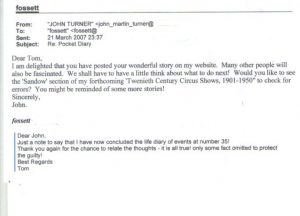
My last contact with John Turner.
Part Two. Events from 1940.
The Sandow family.
My family commenced with two great parents, Richard Bratby and Carrie Fossett, two fine performers in equestrian discipline, riding upon both one horse, in my mother as a fine lady ballerina, and upon two, as in the traditional double riding act. Prior to starting their tenting circus in 1927 they worked the best theatres around the country performing a fine adagio and table balancing act with one appearance at the City Varieties theatre in Leeds.
My arrival was during the build up in Pontardawe, South Wales on the 20th May 1940 with the then show title Sandows Circus. My parents had three other children, my two sisters Violet and Margaret and brother Richard junior.
The period 1940 was of course exceptionally hard for circus in England. Petrol was in short or no supply, our show lorries were laid up and horses once again, moved everything. Movement was heavily restricted with movement in the south of England almost impossible hence the tour in Wales at that time. It seems that the authorities were ‘paranoid’ about all travellers (in the old sense meaning showmen, now the word is misused) although, generally, they thought circus and showmen provided a useful alternative to depressing thoughts of war. May 1940 was the most depressing, for my arrival occurred during the evacuation at Dunkirk. The government decided, at the commencement of war, to close all venues of entertainment so throwing hundreds of acts out of work, albeit for a short time, until better sense was restored. They then realised that the public needed cheerful diversion as much as a focus on the war. The policy I suppose was to focus public attention on the crisis but closing down avenues of enjoyment was the wrong answer.
Business during the war years was generally good although the public may not have been at their best receptively speaking. London theatres were packed with great shows and places to escape worries and sometimes allowing patrons to sleep!
The war years progressed and my childhood was pleasurable and exciting. The family were most gifted and work upon the Variety stage during the winter periods was both plentiful and rewarding. Though supplies were short the people ‘pulled together’ as a team and everyone felt purposeful.
Partnership with Chipperfields.
For the year 1941 my parents formed an equal partnership with the Chipperfields who introduced wild animals to the combined show. My parents were equestrian ‘fanatics’ and ‘wild stuff’ as they called it did not interest them much, even so the business was terrific apparently. Father and Richard Chipperfield Senior formed a successful bond for some years until 1945 I think at which time Chipperfield’s commenced tenting a much larger show themselves to form eventually, the largest in Britain along with Billy Smarts and Bertram Mills, who had ceased touring during the war years, while apparently Mr. Mills worked in high office with the government. I know that my father and Richard Chipperfield remained firm friends; it was a matter of different business interests. Perhaps a large show did not interest my father? During the late 1940s I was overlooked somewhat practice-wise not that I was too bothered myself. There was no opportunity to practice during the winters in so many theatres; I was most certainly spoiled with an abundance of toys and books and many people to meet socially. But, as we shall see the late 1940s were not happy years.
At the close of the war work was still plentiful but conditions were even worse than before with food queues and shortages everywhere. Sweets were a luxury and rationed until the 1950s.
During the winters the family stayed in ‘digs’ for each theatre booking. My thoughts of different lodging and houses were always positive and rather exciting. Walking down a certain road, with personal luggage, one would guess which house it might be at a distance. (Stage props and luggage would be delivered direct to the theatres from the stations, such was the well organised system). Although staying in ‘digs’ has been rather mocked by Variety people in talk shows I always thought they did their best generally in tough days for the house letters. They did their best in the circumstances and were most fair, though understandably not always able to keep the house totally warm. Sometimes the theatres were not much better heat wise.
The theatres were strict about children being on stage or even allowed in the theatre at all and most weeks I would be left with the ‘landlady’ of the house to be looked after and this was fine in the kitchen or front room with the only fire. Some landladies were very caring and entertaining with games and such. No TV but they always had a radio or records. Around 8 p.m. I would be sent off to a bedroom not wanting to sleep but waiting – in the dark – for the family to return at around 10.30 or 11 p.m.
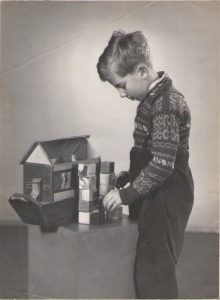
A Studio photograph of me taken when about four years of age. During some Variety week no doubt.
Bad luck Days.
The family circus ventured to the Republic of Ireland for the 1947 season where, at least, food was more plentiful.
My oil colour of a lost photograph of the family circus after leaving the Chipperfield partnership. Many acts were engaged including Derrick Rosaire and family that had the Pets Corner shown on the right. Derrick was most successful with his horse Goldie who worked top bookings including the London Palladium. One will notice that on a closed field the ponies would be loose to graze. (This painting is available as a print, size 18 ins x 14 ins. Details via the e-mail).

The Irish circus tours were quite good but they made the mistake of going across again for the 1948 season and it must be said that other Irish shows then made life difficult and subsequently the family lost much wealth over there that year and had to sell much including livestock to find the boat fare back to Liverpool before the tour was concluded, probably in August. Our quite large circus outfit never really recovered.
That year saw the initial and real break up of the family for my brother Richard, who had recently married another well known circus artiste of a family with the show, decided suddenly to leave. Both were quite young at the time, he being 22 years and his young wife only 17 years. Along with a child, they decided to leave at this very bad time rather than keep the family together or even stay until the show was all safely back in England. Father thought this was most unprofessional and said so. One should always finish a seasons contract. By doing this Richard lost the obvious opportunity to inherit and manage a very viable circus, being that our father clearly expected this of him. Frankly my parents then lost any real happiness in running a circus – it became a chore -and far too much work for my sisters. They stopped self-employment tours in 1949.
Richard and his new wife developed an act to tour independently, a knockabout comical dancing act. Richard had not been with the show much anyway having been in the army during 1945. He and father did not always see things the same way, my father thought Richard would tend to please others more than his family. It must be said that their dancing speciality act found plentiful work in top theatres. My sisters were at prime performance level with their trapeze act ‘The Sandow Sisters’ and toured with my parents, providing much of a given Variety bill along with six Shetland ponies and a large comical dog act. Father had great pride in his borrowed show name ‘Sandow’ having used it since the end of WW1, and I have been most proud to have used it constantly since. He requested that Richard should not use the name professionally and Richard did not do so professionally. Another unwritten nicety in showbusiness.