links



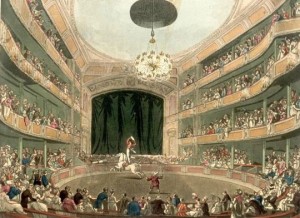
Astley’s Royal Amphitheatre (Monday 25th August 1828)

Andrew Ducrow (1793–1842) was a British circus performer, often called the “Father of British circus equestrianism” and “the Colossus of equestrians”. He was the originator of horsemanship acts and proprietor of Astley’s Amphitheatre . Ducrow was trained by his father who had immigrated to England from Belgium in 1793. The “Courier of St. Petersburg”, his most famous act, was the forerunner to modern horse acts and is still performed today at equestrian events.
Ducrow performed within the United Kingdom and in Europe, including in famous venues such as Covent Garden and Drury Lane. He is most famous as the proprietor of Astley’s Amphitheatre, where he was also the chief performer. Referred to by some as “the Chippendales of his day,” Ducrow and his sons would dress in “fleshings” (flesh-coloured body stockings) and would perform physique poses posed as plastiques while standing upon the rumps of white stallions which could carry them round the amphitheatre several times.

Philip Astley (1742 – 1814) is considered the creator of the modern circus. Born in Newscastle Under Lyme his father was a carpenter and cabinet maker. Philip served in the 15th Light Dragoons cavalry regiment. He was a large man being 6ft in height and a fine horseman who trained new horse for the regiment. He obtained is discharge with honour on the 21st June 1766 and the general of the regiment gave to him a gift of a white charger he called Gibralta.
Trick riding exhibitions were very popular at the time but the more lavish equestrian court entertainments had ceased to be affordable. Philip Astley then became a showman. In 1768 he had secured a piece of land known as Glover’s Halfpenny Hatch between Blackfriars and Westminster bridges and opened a riding school. He then presented his ‘Feats of Hosemanship’ within a circular arena that proved perfect for the audience to view from all sides and also for the riders to perform upon the horse skills of standing balance and trick riding.
London had seen the developement of the commercial theatres – supported by ticket sales. All the theatres then relied upon visual acts and artistes such as jugglers, ropedancers and acrobats within the legit theatres interspersed between the various theatrical offerings. In the eighteeth century the performing artistes were not so segregated, actors, musicians, dancers, acrobats and equestrians all belonged to the same community of entertainers*. Additionally, theatre performers were usually capped with ‘after pieces’ in most cases pantomimes. Fanciful spectaculars with stage tricks and special effects and were the realms of the Clown and the Harlequine.
*Later caled the Variety theatres!*
Philip Astley, for his 1770 season presented a mixture of equestrian and circus acts, followed by pantomime. A circular ring and also a stage too. The farcical works of the clowns, original theatrical charactors, were a welcome addition to the performance. Astley’s new formula was an emmediate success and with it a new form of entertainment came into being – the circus!
Although it is stated Astley did not invent or re-invent the title. His title was; ‘Astley’s Amphitheatre of Equestrian Arts’. Sometime later his rivals Charles Hughes and Charles Dibdin were first to use the title as ‘Royal Circus’ some distance from Astley, on 4th November 1782.